
The Emergence of Green-Fintech: A Weak Signal Poised to Transform Climate Finance and Beyond
The nexus of finance, technology, and climate action is evolving rapidly, driven by escalating regulatory pressures, digitalization advances, and mounting urgency to decarbonize global economies. A weak signal gaining traction is the rise of green-fintech platforms—digital tools and marketplaces designed specifically to streamline carbon finance, renewable investments, and sustainable asset management. This emerging sector, showcased vividly by developments in markets like Vietnam’s impending Carbon Credit Exchange, has potential to disrupt traditional financial industries, reshape climate finance flows, and accelerate the transition to low-carbon economies. Understanding this trend is crucial for businesses, governments, and investors navigating climate risk and opportunity in the next two decades.
What’s Changing?
Climate finance commitments are scaling globally in both ambition and complexity. COP 30’s Baku-Belem Roadmap targets a monumental $1.3 trillion in annual climate finance by 2035, aiming to mobilize consistent flows toward renewable energy and low-carbon infrastructure. However, delivering on these targets requires navigating geopolitical realities, notably China’s dominant role in manufacturing and raw materials critical for clean technologies (Financier Worldwide).
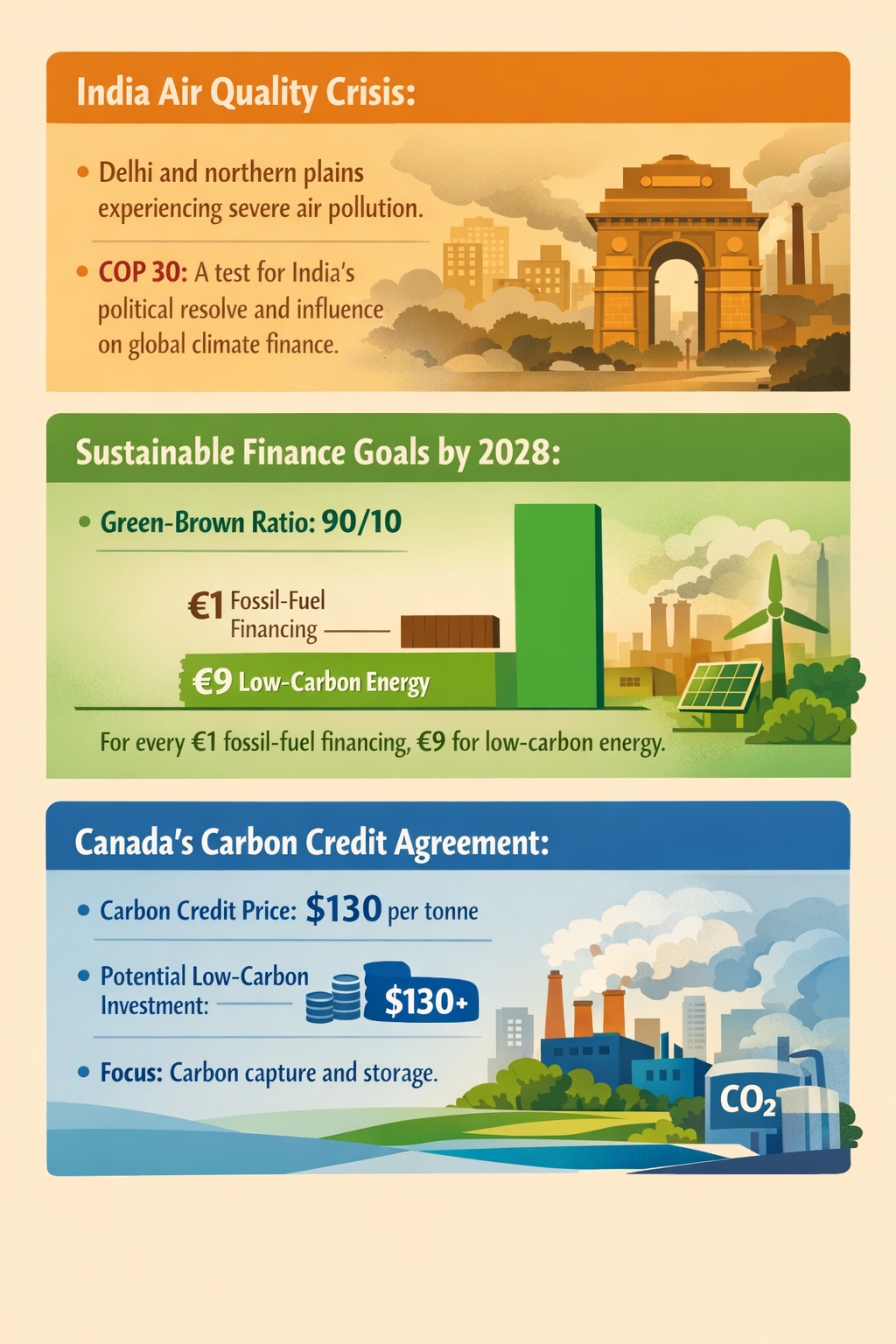
Behind these headline figures, new financial goals reflect a shift in the balance of funding between fossil fuels and green energy. For instance, the goal of achieving a 90:10 green-to-brown financing ratio by 2028 signals stronger regulatory pressure on financial institutions to prioritize climate-friendly investments (GreenDigest).
The increasing complexity and scale of climate finance have paved the way for technology-enabled solutions. Vietnam’s preparation to launch a Carbon Credit Exchange introduces an innovative fintech ecosystem intended to act as an enterprise resource planning (ERP) system for carbon—what some refer to figuratively as building the “SAP for Carbon.” This platform is expected to enable startups and financial players to automate carbon credit creation, certification, trading, and reporting, enhancing transparency and market liquidity (Vietcetera).
Simultaneously, other regions plan sizable financial commitments in climate action, such as Canada’s $20 billion allocation over five years towards international climate finance. These flows may pair with emergent digital tools aiming to maximize impact and efficiency (Policy Alternatives).
One of the less highlighted but vital changes is the move toward unified, mandatory disclosure standards for sustainability in finance. This regulatory convergence is creating demand for robust data integration and analytical tools that fintech startups can develop to meet compliance, risk assessment, and strategy needs of financial institutions and corporate clients (Sustainable Finance Daily).
Another potentially transformative development is digitalization’s impact on infrastructure efficiency. The United Nations Environment Programme (UNEP) has highlighted how digital technologies might save the global grid up to $1.2 trillion in efficiency gains by 2050. This underscores an emerging intersection between fintech, clean energy, and digital infrastructure that could redefine operational and financial models in the energy sector (UNEP).
Why is this Important?
The emergence of green-fintech intersects multiple sectors, offering opportunities and challenges:
- Increased Transparency and Efficiency: Green-fintech platforms can digitize and standardize carbon credit issuance, trading, and reporting, combating fraud and inefficiency. This may increase investor confidence and drive market growth.
- Scaling Climate Finance Flows: Automating processes around sustainable finance lowers transaction costs, making it easier to channel larger volumes of capital toward climate solutions, including in emerging markets.
- Regulatory Compliance and Risk Management: As disclosure standards unify, fintech tools will become essential for real-time compliance monitoring and sustainability performance evaluation, impacting banks, asset managers, and corporates.
- New Market Creation: The rise of carbon exchanges and related fintech ecosystems may create whole new marketplaces and asset classes, reshaping how climate-related financial products are designed, priced, and traded.
- Geopolitical and Economic Shifts: Countries with early adoption or leadership in green-fintech infrastructure could gain competitive advantages in global climate finance, altering economic power structures especially in Asia.
For industries beyond finance—such as energy, manufacturing, and technology—the digitization of climate finance is likely to influence project funding, technology deployment, and operational strategies, thus shaping broader climate outcomes.
Implications
The maturation of green-fintech may bring about several transformative effects over the next 5 to 20 years:
- Financial Democratization and Inclusion: Digitally enabled platforms could allow smaller investors, local governments, and communities to participate in carbon markets or green investments directly, broadening climate finance accessibility.
- Data-Driven Decision Making: Enhanced data analytics embedded in green-fintech will support more granular risk assessments and impact forecasting, potentially changing how financial products are priced and regulated.
- Coordination Challenges and Market Standards: The proliferation of fintech startups and platforms may create fragmentation unless interoperable protocols and global standards develop, requiring international cooperation.
- Geopolitical Dependencies and Risks: Countries like China dominate critical supply chains for green technologies. Green-fintech could either reinforce these dependencies or enable alternative financing models that support more diversified supply chains.
- Economic Growth and Job Creation: The growth of green-fintech sectors could stimulate innovation ecosystems, particularly in emerging economies, contributing trillions in new economic value while accelerating decarbonization.
Organizations that engage early with these digital tools may not only improve compliance and efficiency but also gain strategic insights into climate risks and opportunities, laying groundwork for resilience amid disruption.
Questions
- How can governments and regulators best support the interoperability and standardization of emerging green-fintech platforms to prevent market fragmentation?
- What models exist—or could emerge—that embed green-fintech capabilities directly into existing financial institutions’ workflows to accelerate adaptation?
- In what ways might green-fintech alter power balances between established financial hubs and emerging markets with innovative digital infrastructure?
- How can companies leverage green-fintech tools to not only meet mandatory disclosure requirements but to derive strategic advantage in sourcing sustainable capital?
- What safeguards are necessary to ensure data security, transparency, and ethical governance within automated carbon credit exchanges and green fintech?
- How might advancements in digitalizing climate finance influence other infrastructure sectors beyond energy and finance, such as transportation or urban development?
Exploring these questions may help planners anticipate and shape how green-fintech transforms climate finance and global sustainability efforts over the coming decades.
Keywords
green-fintech; carbon credit exchange; sustainable finance; climate finance; climate disclosure; digitalization; carbon markets; climate risk
Bibliography
- COP 30's Baku-Belem Roadmap targets $1.3 trillion in annual climate finance by 2035, but delivery depends on navigating China’s dominance across manufacturing and materials. Financier Worldwide
- New sustainable finance goals, including a 90/10 green-brown ratio by 2028, meaning every €1 of fossil-fuel financing will be matched with €9 for low-carbon energy. GreenDigest
- Green-Fintech: As Vietnam prepares for the launch of its Carbon Credit Exchange, startups will emerge to build the SAP for Carbon. Vietcetera
- For India, which is facing one of its worst air-quality years as Delhi and the northern plains choke under toxic smog, COP 30 is both a test of political resolve and an opportunity to shape the future of global climate finance. Policy Circle
- The core trend dominating sustainable finance in 2025 and 2026 is the convergence toward unified, mandatory disclosure standards. Sustainable Finance Daily
- The AFB will commit $20 billion over five years for Canada’s fair share of international climate finance. Policy Alternatives
- Italy highlighted its increased climate finance and commitment to scaling 3DEN globally, while UNEP stressed that digitalization could save $1.2 trillion in grid efficiency by 2050. UNEP