
Emergence of Fragmented Multilateralism: A Weak Signal Reshaping Global Governance and Strategic Planning
Multilateral cooperation has long been the backbone of managing global challenges ranging from climate change to catastrophic risks. However, a weak but accelerating signal is emerging: the fragmentation of traditional multilateralism into competing coalitions and transactional diplomacy. This shift could disrupt international cooperation frameworks, affecting industries, governments, and societies around the world. Understanding this evolving landscape is critical for strategic planners who must navigate a multipolar, contesting world order increasingly defined by misaligned institutions, fragile alliances, and geopolitical rivalry.
What's Changing?
Multiple recent developments indicate a marked deterioration in established multilateral norms and institutions, signaling the rise of fragmented and transactional international relations rather than cohesive global governance. The near-term future may witness more coalitions of convenience, ad hoc diplomacy, and assertive unilateralism that challenge the previous era’s assumptions about sustained, rule-based multilateral cooperation.
First, geopolitical tensions between major powers are crystallizing. A dense web of risks involving a transactional United States, assertive China, volatile markets, and environmental stress is shaping the global environment. Unlike in previous decades, power competition is less about ideology and more about pragmatic calculations of influence and control. This leads to purposeful disengagement from previous commitments and the formation of shifting alliances rather than long-term institutional partnerships.
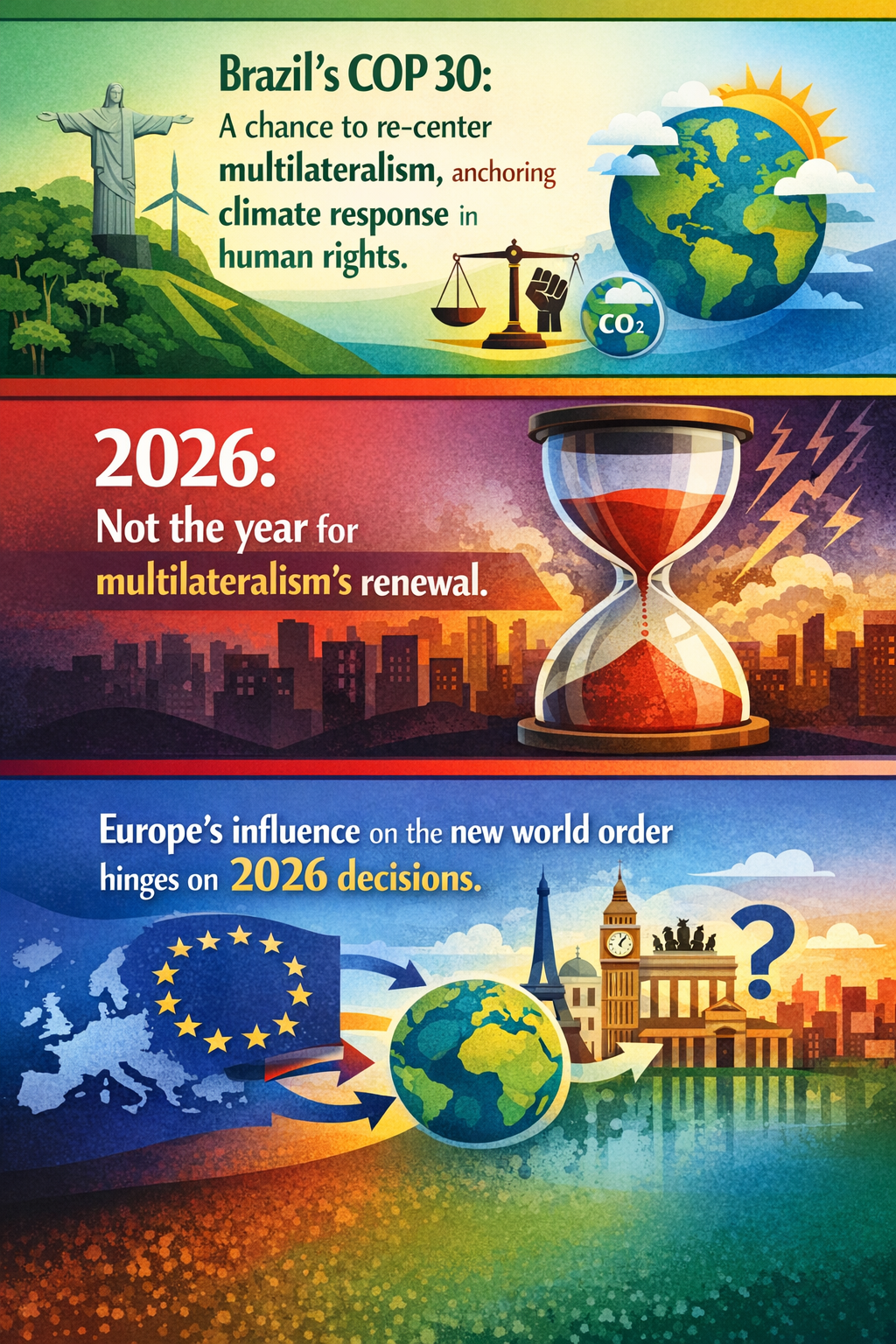
Second, multilateral institutions, long seen as mechanisms for collective action, appear increasingly strained or sidelined. According to analysis on the downward trajectory of global governance structures (Tomorrow Is Possible, 2026), 2026 is expected not to mark a renewal but a further decline in multilateral momentum. Efforts to reform or revitalize global institutions face powerful resistance, including from influential states that view cooperation as a threat to national power. This institutional misalignment is not unprecedented but now clearly a defining feature of global governance amid complex crises (Global Governance Forum).
Third, some states are seizing opportunities to lead new forms of middle-power diplomacy, which emphasize coalition-based multilateralism outside traditional frameworks. India, for instance, is positioning itself to stabilize regional cooperation by supporting institutional reforms that may bypass or reshape old global institutions (IAS Baba). Such efforts could represent emerging alternatives to rigid multilateralism, but they also risk fragmenting the international order further by privileging selective partnerships over universal rules.
Finally, critical areas like climate governance reflect these fractured dynamics. The upcoming COP 30 in Brazil presents a pivotal moment to attempt recentering multilateralism through linking climate action with human rights and social equity (Human Rights Watch). Yet, even climate cooperation is increasingly viewed in some quarters as a challenge to national sovereignty or strategic power, with certain states framing international environmental law as threatening national interests (Countercurrents).
Why is this Important?
The fracturing of traditional multilateralism is more than a governance issue; it carries wide-ranging implications across sectors and geographies that could escalate risk and disrupt established operations.
Businesses may find international regulatory regimes less predictable or cohesive, complicating compliance and increasing exposure to geopolitical risk. Fragmentation implies that global standards on trade, environmental sustainability, digital governance, or supply chain resilience may diverge or be selectively enforced, driving costs and necessitating more sophisticated geopolitical risk management.
Governments will face elevated challenges in building consensus on shared threats such as pandemics, climate catastrophes, or cybersecurity. Without stable multilateral platforms, coordination may become episodic or conditional, impeding rapid joint action and fostering duplication or competition rather than complementarity.
Civil society and research communities could see funding and collaboration on global issues become more contingent on alignment with fragmented coalitions, diminishing the neutrality and effectiveness of international scientific and humanitarian efforts.
In sum, this weak signal of disruptive fragmented multilateralism may usher in a more anarchic but also more transactional international landscape. This carries the potential for heightened uncertainty, fragmented policy responses, and uneven progress on critical global challenges.
Implications
For strategic planners and decision-makers, anticipating the rise of fragmented multilateralism involves broadening foresight beyond traditional multilateral institutions toward a more heterogeneous set of international actors and governance structures.
Key implications include:
- Adaptable Partnerships: Organizations may need flexible alliance-building strategies that accommodate transactional diplomacy and shifting coalitions, rather than relying solely on enduring institutional memberships.
- Geopolitical Risk Integration: Scenario planning should incorporate fragmented governance scenarios alongside traditional multilateral ones, including assessing impacts on supply chains, regulations, and crisis response.
- Cross-sectoral Cooperation: Given institutional fragility, businesses, governments, and NGOs might increasingly collaborate directly on issues like climate change or health security, bypassing formal multilateral channels.
- Innovative Governance Models: There is an opening for new governance experiments that merge regionalism, digital cooperation, and issue-specific coalitions as alternatives to broad but brittle institutions.
- Enhanced Monitoring of Emerging Coalitions: Tracking nascent middle-power diplomatic efforts and ad hoc blocs could reveal early shifts in global influence and inform strategic engagement decisions.
Early recognition and response to these dynamics could position stakeholders to benefit from reconfigured governance architectures, reduce risk exposure, and identify novel collaboration opportunities.
Questions
- How might fragmented multilateralism affect your sector’s global regulatory and operational environment in the next 5-10 years?
- What new coalitions or diplomatic formations could influence your strategic priorities, and how can you engage proactively with them?
- How can scenario planning incorporate complex global governance breakdowns or hybridity between formal institutions and ad hoc coalitions?
- What partnerships outside traditional state-centric frameworks could your organization develop to mitigate risk or seize emergent opportunities?
- How should your risk management approach adjust to rising geopolitical transactionalism and institutional misalignments?
Keywords
fragmented multilateralism; geopolitical risk; middle-power diplomacy; global governance; coalition-based multilateralism; climate governance; international law; transactional diplomacy
Bibliography
- Global catastrophic risks 2026: Timely insights amid mounting strains. Global Governance Forum
- Opportunity for Middle-Power Diplomacy: India can play a stabilising role by supporting institutional reform and coalition-based multilateralism. IAS Baba
- Looking Ahead 2026: India at the Crossroads. The Indian Eye
- 2026 will not be the year multilateralism renews itself. Tomorrow Is Possible
- Isolate the United States: Climate cooperation, international law, humanitarian norms, and shared global governance framed as threats to American power. Countercurrents
- Q&A with COP 30 host Brazil on re-centering multilateralism and anchoring climate response in human rights. Human Rights Watch