
The Rise of Hybrid Satellite-Terrestrial Networks: A Weak Signal Poised to Disrupt Connectivity
In the next five to ten years, hybrid satellite-terrestrial networks are emerging as a transformative infrastructure to redefine global connectivity. While 5G deployments and satellite constellations individually receive widespread attention, their convergence is a relatively underexplored development with the potential to disrupt telecommunications, IoT applications, and critical infrastructure worldwide. This shift is fueled by advances in regulatory alignment, network technology standards, and satellite deployment strategies, which collectively signal a notable pivot in how networks will be architected and scaled.
What’s Changing?
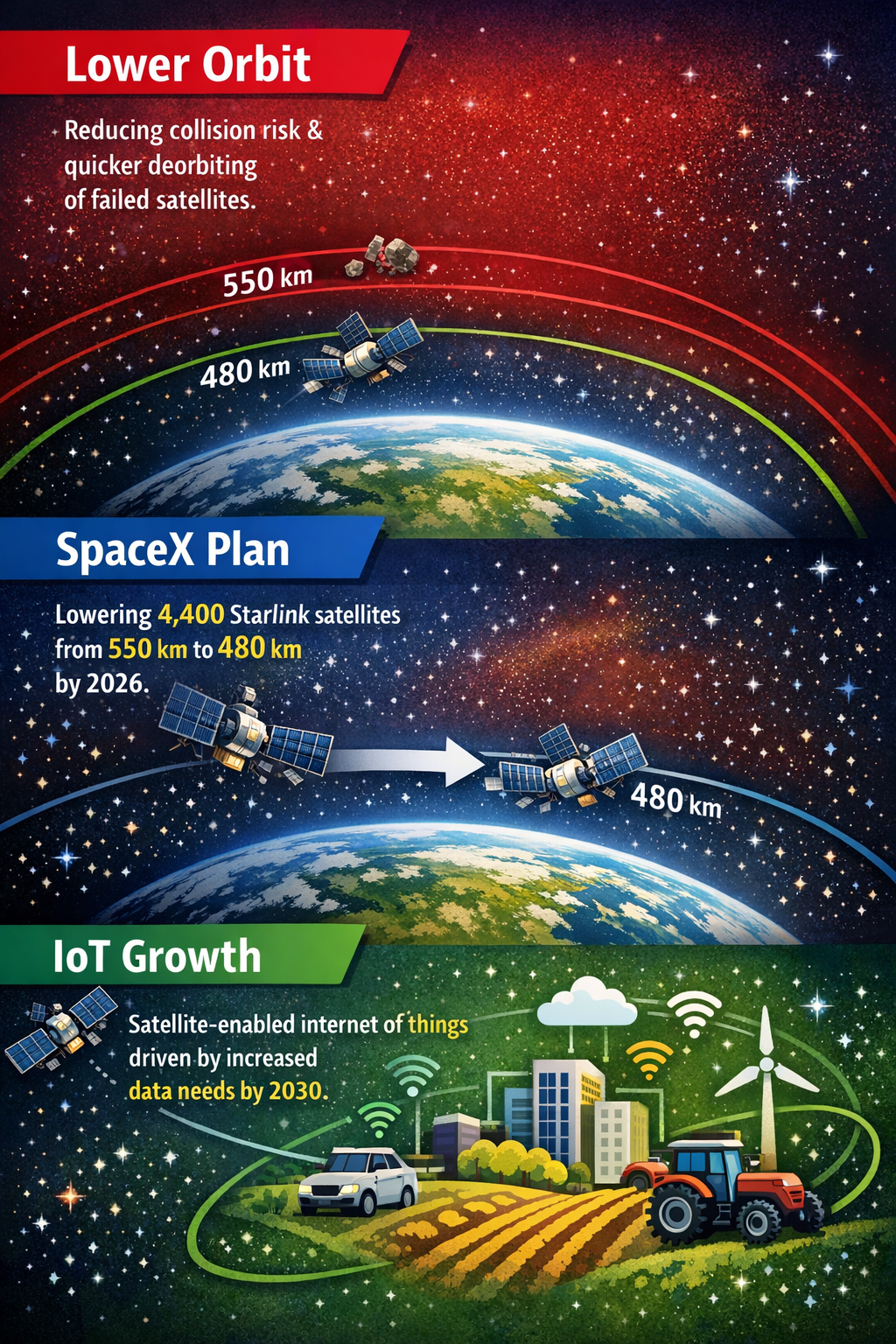
Traditional terrestrial networks face inherent limitations in coverage, deployment speed, and resilience. Meanwhile, numerous satellite constellations—including SpaceX’s Starlink, Amazon Kuiper, and China’s Guowang network—are dramatically increasing low earth orbit (LEO) satellite traffic. These fleets offer new opportunities for broad connectivity but raise complex operational challenges in space traffic management and signal integration (ScienceTimes).
Recent technological and regulatory milestones point toward the merging of terrestrial 5G networks with non-terrestrial satellite networks. This hybrid approach is gaining momentum especially with the upcoming releases of 3GPP (3rd Generation Partnership Project) Release 17 and 18, which include specific standards enabling tighter integration between satellites and terrestrial cellular infrastructure (Voice&Data).
Starlink is an illustrative case: following massive deployments in 2025, the introduction of its V3 satellites and 1 gigabit-per-second service upgrades slated for 2026 could facilitate hybrid use cases by pairing its expansive satellite coverage with terrestrial 5G capabilities, especially in underserved regions or during disaster recovery (DishyTech).
The regulatory groundwork for 6G, expected around 2028–2030, is also being laid now, with an eye toward incorporating non-terrestrial networks as foundational elements. This integration will likely demand fresh spectrum management policies and collaborative interoperability standards for both terrestrial and satellite ecosystems (WrayCastle).
The IoT sector, expected to surpass 30 billion connected devices by 2030, will likely push demand for ubiquitous, reliable connectivity far beyond current terrestrial limits. Hybrid networks could provide seamless handoffs between satellite and 5G terrestrial nodes, enabling consistent device responsiveness anywhere on Earth—overcoming dense urban network congestion and remote coverage gaps (Wireless Logic).
Why is this Important?
The emergence of hybrid satellite-terrestrial networks could reshape multiple industries simultaneously:
- Telecommunications: Network operators may extend coverage rapidly and cost-effectively, especially in areas where terrestrial infrastructure buildout is infeasible due to geography or capital expenditure constraints.
- Emergency and disaster response: Hybrid networks could ensure resilient communications are intact even if terrestrial sites are damaged or overloaded, improving first responder coordination and public safety alerts.
- IoT and Industry 4.0: Seamless connectivity enables real-time monitoring and control for remote sensors, agricultural equipment, and industrial automation, enhancing operational efficiencies globally.
- Transportation and mobility: Enhanced in-flight or maritime connectivity may evolve with these networks, offering higher speeds and lower latencies, disrupting traditional satellite-only service providers.
Additionally, hybrid networks address long-standing latency and throughput disparities inherent in satellite-only systems. By offloading latency-sensitive traffic to terrestrial 5G where available, user experiences could improve significantly, while satellites maintain broad coverage and redundancy.
Implications
This trend highlights several strategic challenges and opportunities:
- Regulatory complexity: Governments and international bodies will need to collaborate to harmonize spectrum allocation, mitigate orbital debris risks, and ensure network security across terrestrial and space domains.
- Infrastructure investment: Network operators may need to balance investments between upgrading terrestrial 5G infrastructure and leveraging satellite capacity, requiring new business models and partnership strategies.
- Technological innovation: Device manufacturers must develop user equipment capable of switching seamlessly between satellite and terrestrial signals, optimizing battery usage and network selection.
- Data privacy and security: Integrating terrestrial and satellite data streams might increase attack surfaces, necessitating enhanced cybersecurity protocols and standardized encryption frameworks.
Hybrid connectivity could also democratize access to high-performance networks, narrowing the digital divide between urban and rural areas. However, uneven adoption and coordination failures could risk regulatory bottlenecks and create fragmented user experiences.
Questions
- How can regulatory frameworks evolve to support seamless terrestrial-satellite integration without stifling innovation or competition?
- What partnerships between satellite operators, mobile carriers, and technology vendors will prove critical for hybrid network success?
- Which industries stand to benefit most from hybrid connectivity models, and what new use cases might emerge?
- How can organizations plan for the security risks inherent in interconnected non-terrestrial and terrestrial networks?
- What strategies should businesses adopt today to prepare for hybrid network capabilities expected over the next decade?
Keywords
hybrid networks; 5G broadcast; low earth orbit satellites; internet of things; telecommunications regulation; satellite constellations; 3GPP Release 17; network security
Bibliography
- Commercial 6G deployments are expected around 2028-2030, but the regulatory groundwork is being laid right now. WrayCastle. https://wraycastle.com/blogs/knowledge-base/telecom-regulation-2026-what-industry-leaders-need-to-know?srsltid=AfmBOopc4eg7RMosOovqV8QeLqLhVC5v2zayv2JzWwEBu7zMmdq7Xi4q
- Thousands of satellites, including Starlink, Amazon Kuiper, and China's Guowang, increase LEO traffic, creating both connectivity opportunities and operational challenges. ScienceTimes. https://www.sciencetimes.com/articles/61116/20260112/thousands-satellites-crowd-earths-orbit-raising-risks-changing-space-traffic.htm
- Hybrid satellite-5G networks are expected to move from pilots to deployment in 2026, driven by 3GPP Release 17 and 18, enabling closer integration of terrestrial and non-terrestrial networks. Voice&Data. https://www.voicendata.com/5g/2026-set-to-unite-satellite-and-5g-networks-10982128
- With the new V3 satellites and 1 gig service coming in 2026, Starlink is expected to release newer Standard and Mini antennas to take advantage of the network upgrades. DishyTech. https://www.dishytech.com/starlink-just-had-a-massive-2025-and-2026-could-be-even-bigger/
- The IoT is forecast to grow to 21.9 billion connections in 2026 and around 30 billion at the start of the next decade. Wireless Logic. https://wirelesslogic.com/blog/five-iot-trends-for-2026