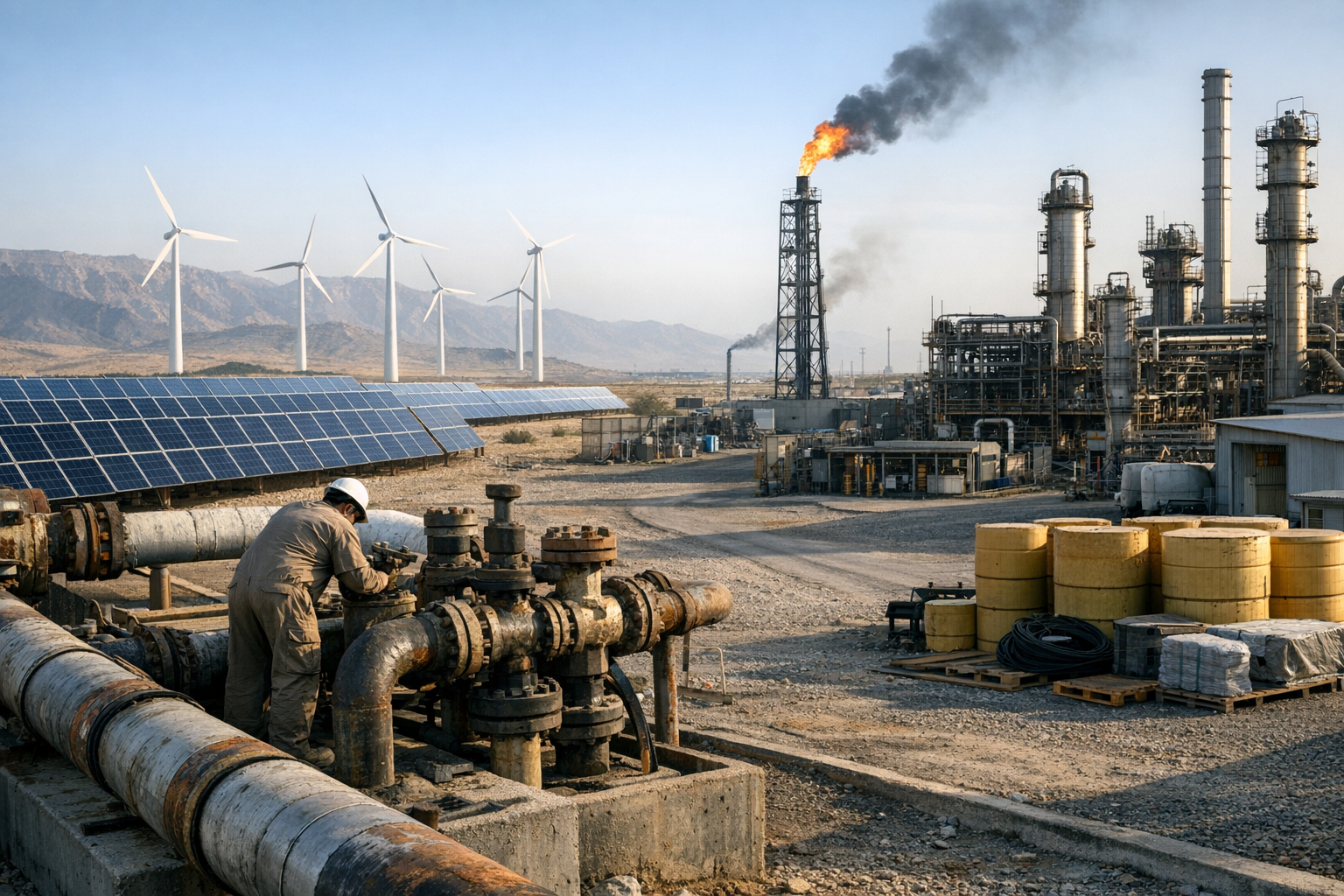
Board Snapshot: Managing in a Resource-Constrained World
April 2026 | Strategic Intelligence Brief | 3-5 Minute Executive Read
Top 3 Board-Critical Risks
1. Middle East Energy Chokepoint Disruption
The Iran conflict has transformed the Strait of Hormuz into an active flashpoint, with attacks on LNG and oil facilities tightening global supply. Energy prices have surged, with Brent briefly touching $119. Continued disruption threatens a 125% YoY energy cost surge, directly impacting operating margins and supply chain costs.
Primary statistics from IEA and Reuters; directional consensus across Tier 1-2 sources
Pre-authorised Activate hedging protocols if Brent exceeds $125 for 5 consecutive days
2. Critical Mineral Supply Chain Fragmentation
Global investment must reach $260 billion annually through 2035 to meet energy-transition metal demand—current investment stands at $186 billion. China controls chokepoints across lithium, rare earths, and battery materials. Supply deficits could emerge as early as 2028.
IEA and Octave institutional research; corroborated across multiple Tier 2 sources
Awaiting Board Direction Strategic sourcing partnerships require capital allocation decision
3. Climate-Driven Operational Exposure Acceleration
Climate risks are evolving faster than previously assumed. Businesses without resilience measures could lose up to 7% of earnings annually by 2035. ASEAN faces up to 120 days annually above 35°C by 2050; India's infrastructure pipeline ($4.51 trillion) faces 2% GDP annual climate costs.
IPCC and WMO primary data; FedEx/McKinsey institutional analysis
Prepare Climate resilience investment framework required Q3 2026
Top 2 Upside Opportunities Under Stress
1. Long-Duration Energy Storage Market Entry
Demand for grid-scale storage is accelerating—US projected to install 15 GW of new BESS capacity in 2026. Western firms have a rare window to compete with China in long-duration storage technologies as the market diversifies beyond lithium-ion.
2. Carbon Market Infrastructure Positioning
Brazil's regulated carbon market launches 2030; EU CBAM enters full compliance 2027. First-movers in emissions verification and carbon pricing documentation infrastructure will capture compliance revenue across multiple jurisdictions.
Top 3 Trigger Events Requiring Immediate Escalation
1. Hormuz Strait Closure or Major Infrastructure Attack
Any sustained closure or attack on Saudi Aramco/UAE facilities triggers immediate energy cost escalation protocol and supply chain rerouting.
2. China Export Controls on Critical Minerals
Expansion of China's supply chain security regime (Article 13) to restrict critical mineral exports requires immediate supplier diversification activation.
3. El Niño Declaration with Extreme Intensity Forecast
Indonesian agencies monitoring for potential "Godzilla El Niño" from July 2026—declaration triggers agricultural supply chain stress protocols.
Any pre-authorised action escalates to the Board if defined financial, liquidity, or exposure thresholds are breached.
Executive Synthesis
What Has Materially Changed Since Last Cycle
The Iran conflict has shifted from price shock to supply shock. What began as energy price volatility has evolved into structural supply chain disruption affecting shipping routes, insurance costs, and commodity availability. The German economy has entered "crisis mode" with the ifo index dropping to pandemic-era levels. Simultaneously, climate adaptation has moved from planning horizon to operational urgency—India has formally mainstreamed disaster resilience into its $4.51 trillion infrastructure pipeline, and the TNFD framework is transitioning to mandatory global standards under ISSB by late 2026.
The 3-5 Risks and Opportunities Dominating Leadership Attention
- Energy Security vs. Transition Trade-off: The Iran war has created a policy paradox—nations are accelerating clean energy investment for security reasons while simultaneously returning to coal to manage immediate supply gaps. Changes in energy policy could "unravel much of the progress the world has made toward decarbonization" (The Guardian).
- China's Structural Advantage in Clean Tech: China is positioned to benefit from energy disruptions as the world's dominant producer of solar panels, batteries, and clean technologies. The world's largest oil and gas importer is using this vulnerability to accelerate domestic clean energy expansion—all additional electricity demand through 2030 will be met by low-emissions sources (IEA).
- Regulatory Fragmentation Requiring Multi-Jurisdictional Compliance: EU CBAM, California's SB 253, Brazil's carbon market, and China's Article 13 supply chain security regime are creating overlapping compliance obligations with conflicting requirements. Firms must invest in parallel compliance infrastructure or face market access restrictions.
- Data Centre Energy Demand Collision: AI-driven power demand is projected to increase 130% by 2030 in the US alone. Fossil fuels will meet over 40% of this demand through 2030, creating tension between digital transformation and decarbonisation commitments.
- Climate Resilience as Investment Thesis: Asian companies could see $11 return for every dollar invested in resilience measures. Climate startup opportunities are shifting from carbon narratives to resilience infrastructure—this is now an investable category, not merely a risk management cost.
Why These Matter in the Next 6-18 Months
The convergence of energy supply disruption, accelerating regulatory compliance deadlines, and physical climate risk materialisation creates a compressed decision window. EU CBAM enters full compliance in 2027. Brazil's carbon market launches 2030 but requires infrastructure investment now. The IEA's net-zero scenario requires global renewable capacity to triple by 2030—an 18-month window to position for the acceleration. Meanwhile, El Niño conditions expected from July 2026 could trigger agricultural supply chain stress precisely when energy costs remain elevated.
3 Concrete Leadership Decisions That Cannot Be Deferred
- Energy Hedging and Diversification Strategy: Current hedging positions must be stress-tested against sustained $120+ oil scenarios. Board must decide on acceptable cost of hedging vs. exposure tolerance by end of Q2 2026.
- Critical Minerals Sourcing Framework: With supply deficits possible by 2028 and CFIUS scrutiny intensifying, the organisation must determine whether to pursue strategic partnerships with allied-nation suppliers or accept Chinese supply chain dependency. Decision required before 2027 capital allocation cycle.
- Climate Resilience Capital Allocation: The 7% earnings-at-risk figure by 2035 requires a board-level decision on resilience investment quantum. Defer beyond Q3 2026 and insurance/financing costs begin reflecting unmitigated exposure.
A Finding That May Challenge Base Assumptions
The assumption that energy transition will increase costs may be inverting. Solar alone is now competitive with fossil power on pure capex basis, and solar-plus-storage is expected to follow by 2030. The WindEurope/Hitachi scenario shows a renewables pathway with only 22% energy import dependency by 2050 versus 54% in slow-transition scenarios. The Iran conflict may accelerate this inversion rather than delay it—European rooftop solar demand has surged since the war began.
What Would Force a Change in Direction
- Risk-driven: Sustained Hormuz closure exceeding 30 days, triggering strategic petroleum reserve depletion and forcing immediate operational restructuring regardless of cost.
- Policy/Regulatory-driven: US reversal of IRA incentives or EU CBAM delay beyond 2028, which would fundamentally alter the economics of current transition investments.
- Market/Capital-driven: Credit rating agencies formally incorporating unmitigated climate exposure into sovereign and corporate ratings, repricing cost of capital for non-resilient portfolios.
Where This Analysis Could Be Wrong
This synthesis assumes the Iran conflict remains contained to the Gulf region and does not escalate to direct US-Iran military engagement beyond current parameters. If the conflict expands to include attacks on US bases in the region or direct Iranian nuclear programme targeting, the energy price and supply assumptions become materially understated. The single most falsifiable assumption is that Hormuz remains navigable, even if contested—a full closure scenario would require immediate revision of all supply chain and cost projections, with energy prices potentially exceeding $150/barrel and triggering demand destruction that invalidates current growth forecasts.
Key Findings
Energy Systems & Transition Pathways
The One Thing That Matters: Energy security and energy transition have converged into a single strategic imperative—the Iran conflict is accelerating clean energy investment while simultaneously exposing fossil fuel dependency.
Why This Is Changing Now
- Supply shock materialisation: The war has shifted from price volatility to physical supply disruption, with attacks on Middle East LNG and oil facilities tightening global supply (Bakery and Snacks).
- AI demand collision: Data centres are on course to account for nearly half of all US electricity demand growth through 2030, with fossil fuels meeting over 40% of this demand (Semiconductors Insight).
- Storage economics inflection: US projected to install 15 GW of new BESS capacity in 2026; global storage must increase by 1,500 GW by 2030 to meet Paris Agreement targets (Corporate Knights).
Supporting Signals
- European rooftop solar demand has surged since the Iran war began as households seek to shield themselves from power price volatility (Clean Energy Wire).
- China expects all additional electricity demand through 2030 to be met by low-emissions sources—renewables and nuclear (IEA Electricity 2026).
- Commonwealth Fusion Systems, backed by $1.8 billion including Google and Breakthrough Energy Ventures, targets SPARC demonstration reactor activation by late 2027 (Verodate).
- Buildings sector achieves highest electrification level by 2040, driven by heat pump rollout (Nature Communications).
The Strongest Counter-Argument
The assumption that clean energy transition accelerates under supply stress may be overstated. Coal-fired generation is seeing renewed investment as nations prioritise immediate supply security over long-term transition goals. The Guardian reports that energy policy changes sparked by the Iran war "could unravel much of the progress the world has made toward decarbonization." Renewable energy costs in Europe and North America face upward pressure from permitting delays, limited grid capacity, and higher system balance costs—the transition may slow rather than accelerate if infrastructure bottlenecks persist.
Strategic Implication
DecideEarnings-material
The organisation faces a forced choice: invest in parallel energy infrastructure (both fossil hedging and renewable capacity) at higher cost, or accept concentration risk in one pathway. Current energy hedging positions require stress-testing against sustained $120+ scenarios. The window for securing favourable long-term renewable PPAs is narrowing as demand surges.
Environmental Change & Earth System Stress
The One Thing That Matters: Climate risk has crossed from planning horizon to operational reality—physical impacts are now affecting balance sheets, supply chains, and insurability on timescales shorter than capital planning cycles.
Why This Is Changing Now
- Risk acceleration: Climate effects are evolving on timeframes shorter than previously assumed, with IPCC noting high confidence that concurrent heatwaves and droughts will increase (PMC Research).
- Insurance market repricing: Climate-related risks projected to exceed $100 billion in insured losses annually; 6.8% of UK properties classified high flood-risk, rising to 9.6% under high-emissions scenarios (Kalkine UK).
- El Niño return: Indonesian agencies preparing for potential "Godzilla El Niño" from July 2026, significantly intensifying drought and fire risk across Southeast Asia (Reccessary).
Supporting Signals
- ASEAN could face up to 120 days per year above 35°C by 2050, posing risks to human health, energy security, and economic productivity (ASEAN Centre for Energy).
- Close to $400 billion of US federal government assets, mostly Defence Department, are at high risk of coastal flood or storm damage (Union Bulletin).
- Global water demand expected to exceed supply by 40% by 2030; regions across Middle East, North Africa, and Central Asia face extreme water stress by 2040 (Daily Sabah).
- New York and New Orleans face highest risk of extreme flood damage among US East Coast cities (Live Science).
The Strongest Counter-Argument
The 7% earnings-at-risk figure by 2035 relies on scenario modelling with significant uncertainty bands. The UK's National Risk Assessment explicitly cautions against "deterministic models or speculative migration projections." Focusing on extreme warming levels to communicate risk may hide the potential for extreme climate outcomes at more moderate warming levels—but it may also overstate near-term operational impacts. Many climate adaptation investments have long payback periods that may not survive short-term capital allocation pressures.
Strategic Implication
PrepareCapital-relevant
Climate resilience investment must shift from discretionary to mandatory capital allocation. The trade-off is clear: invest now in resilience at known cost, or face uncertain but potentially larger costs from unmitigated exposure. Asian companies seeing $11 return per dollar invested in resilience measures suggests this is no longer purely defensive spending.
Finance, Technology & Societal Adaptation
The One Thing That Matters: Critical mineral supply chains have become national security infrastructure—the investment gap between current flows ($186 billion) and required flows ($260 billion annually through 2035) represents both systemic risk and strategic opportunity.
Why This Is Changing Now
- Demand acceleration: Mineral demand from clean energy technologies could triple by 2030 and quadruple by 2040 on net-zero pathways (Ecoticias).
- Supply deficit timing: Without significant new investment, supply deficits could emerge as early as 2028, with global lithium demand potentially exceeding 13 million tonnes by 2050 (AInvest).
- Geopolitical weaponisation: China's Article 13 information gathering restrictions create legal risk for ESG and human rights due diligence conducted within China (Squire Patton Boggs).
Supporting Signals
- An economic security alliance focused on addressing shared vulnerabilities in pharmaceuticals, critical minerals, and clean energy technology where China controls chokepoints would be a strong foundation for allied cooperation (Foreign Affairs).
- India's environmental technologies market valued at $23 billion, expected to grow at 7.5% CAGR through 2028, though weak regulatory compliance and corruption remain challenges (US Trade.gov).
- Planned data centre expansions could require $7 trillion in investment, driven by surging demand for compute power, energy, and cooling systems (TechStartups).
- State pension funds could face investment return declines of up to 50% by 2040 if climate policies remain unaddressed (Sierra Club). [Signal confidence: limited—advocacy source]
The Strongest Counter-Argument
The critical minerals "crisis" narrative may be overstated. The convergence of technological innovation in the Americas, the green energy transition, and a shifting Chinese economy has created a window of low commodity prices that could last through the end of the decade. Lithium prices have declined significantly from 2022 peaks. New processing technologies and recycling capacity (EoL EV batteries could meet 100% of California's stationary storage demand by 2050) may reduce primary extraction requirements. The supply deficit timeline of 2028 assumes current technology and no demand destruction from high prices.
Strategic Implication
DecideLiquidity-critical
The organisation must choose between three postures: (1) accept Chinese supply chain dependency and associated regulatory/geopolitical risk; (2) invest in allied-nation sourcing partnerships at premium cost; or (3) invest in recycling and secondary supply infrastructure. This decision affects capital allocation for the next 5-7 years and cannot be deferred beyond 2027 planning cycle.
Governance, Policy & Institutional Response
The One Thing That Matters: Regulatory fragmentation is creating parallel compliance universes—organisations must now maintain simultaneous compliance infrastructure for EU, US, UK, Chinese, and emerging market carbon and supply chain regimes that may conflict with each other.
Why This Is Changing Now
- CBAM materialisation: EU CBAM enters full compliance 2027; UK CBAM follows. Up to 43% of EU gas imports could be deemed non-compliant from 2027 under methane emissions rules (Global LNG Hub).
- Nature disclosure mandatory: TNFD framework transfers to ISSB for mandatory global standard-setting, with exposure draft targeted for COP 17 in Armenia late 2026 (i4n).
- China counter-regulation: Article 13's information gathering restrictions create legal risk for routine compliance, ESG, and human rights due diligence conducted within China (Squire Patton Boggs).
Supporting Signals
- Brazil's regulated carbon market launches 2030, with legislation already set; early positioning in verification infrastructure creates multi-jurisdictional compliance value (Valor International).
- California's SB 253 serves as first and most ambitious US climate data regulation, potentially serving as model for other states (ISS Corporate).
- China's 15th Five-Year Plan underscores nuclear energy as linchpin of energy security, decarbonisation, and industrial competitiveness, with pledges to triple reactor capacity by 2050 (Fifth Row).
- ICAO CO2 emissions standard made 10% more stringent, applicable to new aircraft type designs from 2031 (Green Air News).
The Strongest Counter-Argument
Regulatory fragmentation may prove less durable than current trajectory suggests. The EU's consideration of Article 6 credits in its 2040 target and framing of bilateral carbon agreements as NDC enforcement tools suggests movement toward harmonisation. The Trump administration's efforts to reverse the endangerment finding may fail legally, and the 2026 US election cycle could shift federal policy back toward international alignment. Compliance infrastructure investment may prove over-engineered if regulatory convergence accelerates post-2028.
Strategic Implication
PrepareEarnings-material
Compliance infrastructure must be designed for regulatory divergence as the base case, with optionality for convergence. The emissions verification and carbon pricing documentation built for EU CBAM compliance will serve UK CBAM compliance—invest in modular systems that can adapt to multiple jurisdictional requirements rather than point solutions.
2×2 Scenario Matrix: Structural Futures
Scenarios describe operating environments we may need to live in and adapt to—not discrete shock events.
These scenarios are used to stress-test decisions already under consideration, not to generate new ones.
Critical Uncertainties:
- Axis 1: Energy Supply Stability (Stable ↔ Disrupted)
- Axis 2: International Policy Coordination (Coordinated ↔ Fragmented)
🟢 Coordinated Acceleration
Stable Energy + Coordinated Policy
Iran conflict de-escalates by Q4 2026; Israel indicates it will stop targeting Iran's energy infrastructure. Strategic petroleum reserves stabilise prices below $90. G7 and major economies align on carbon pricing mechanisms; EU CBAM becomes template for UK, Japan, and potentially US state-level adoption. China's 15th Five-Year Plan nuclear expansion proceeds without export control escalation. Clean energy investment reaches $2.5 trillion annually by 2028. Renewable capacity tripling by 2030 becomes achievable. Critical minerals supply chains diversify through allied-nation partnerships under coordinated CFIUS-equivalent frameworks.
"The crisis accelerated what was already inevitable—but made it cheaper and faster than anyone expected."
Positioning: Stability + Coordination
Early Indicators:
- Brent crude sustained below $85 for 60+ days
- US-China bilateral climate agreement renewal with enhanced commitments
- EU CBAM Article 6 credit acceptance formalised
- Allied-nation critical minerals investment vehicle announced
- ISSB nature disclosure standard adopted by G20 finance ministers
🟡 Fortress Blocs
Stable Energy + Fragmented Policy
Iran conflict contained but not resolved; oil flows through Hormuz resume at 80% capacity with elevated insurance costs. Major economies retreat to regional trading blocs with incompatible carbon pricing and disclosure regimes. EU, US, and China each develop parallel supply chain security frameworks that conflict on data sharing and compliance requirements. Clean energy investment continues but fragments into regional technology standards. Critical minerals become subject to export controls and strategic stockpiling. Organisations must maintain three separate compliance infrastructures. Energy transition continues but at higher cost and slower pace due to duplicated investment.
"Everyone is transitioning, but no one is talking to each other—and the lawyers are getting rich."
Positioning: Stability + Fragmentation
Early Indicators:
- China Article 13 enforcement actions against Western due diligence providers
- US CFIUS blocks allied-nation investment in critical minerals
- EU-UK carbon market linkage negotiations fail
- Separate US, EU, and China battery passport standards announced
- Regional renewable equipment certification requirements diverge
🔴 Crisis Convergence
Disrupted Energy + Fragmented Policy
Iran conflict escalates; Hormuz remains contested with periodic closures. Oil prices sustained above $130. El Niño intensifies to "Godzilla" levels, triggering simultaneous agricultural failures across Southeast Asia, drought in Central Asia, and wildfire seasons in Australia and US West. Nations prioritise immediate energy security over transition commitments; coal-fired generation increases globally. Climate adaptation spending crowds out mitigation investment. Insurance markets withdraw from high-risk regions. Supply chain fragmentation accelerates as nations stockpile critical materials. CBAM implementation delayed as EU focuses on energy security. Regulatory enforcement paused for "competitiveness" concerns.
"We're all too busy fighting today's fires to prevent tomorrow's."
Positioning: Instability + Fragmentation
Early Indicators:
- Hormuz closure exceeds 14 consecutive days
- Strategic petroleum reserves fall below 90-day threshold in major economies
- El Niño declared with extreme intensity forecast (July 2026)
- Major insurer announces withdrawal from California wildfire market
- EU announces CBAM implementation delay beyond 2028
🔵 Emergency Coordination
Disrupted Energy + Coordinated Policy
Energy crisis severity forces unprecedented international cooperation. IEA coordinates strategic reserve releases across member nations. G20 agrees emergency critical minerals sharing framework. Clean energy investment accelerates dramatically as security imperative overrides cost concerns—rooftop solar demand surges across Europe. China's clean tech dominance becomes acceptable trade-off for supply security. CBAM implementation accelerates rather than delays as carbon pricing becomes tool for reducing fossil fuel demand. Climate adaptation funding unlocks as $300 billion global climate finance goal becomes politically achievable. Crisis creates political space for policy changes that were previously blocked.
"It took a crisis to remind everyone that we're all in this together—and that clean energy is the only way out."
Positioning: Instability + Coordination
Early Indicators:
- IEA coordinates multi-nation strategic reserve release exceeding 100 million barrels
- G20 emergency summit on energy security announces joint investment vehicle
- EU accelerates CBAM implementation to 2026 for selected sectors
- US-China joint statement on critical minerals cooperation
- COP 17 delivers binding nature disclosure framework with enforcement mechanism
Scenario Assumptions Register
| Assumption |
If Wrong, Impact on Matrix |
| Iran conflict remains conventional (no nuclear escalation) |
Nuclear escalation invalidates all scenarios; requires entirely new framework centred on global economic contraction |
| China does not impose comprehensive critical minerals export ban |
Comprehensive ban collapses "Coordinated" scenarios; forces all outcomes toward fragmentation axis |
| Climate tipping points (AMOC collapse, permafrost methane release) remain beyond planning horizon |
Tipping point activation makes all scenarios obsolete; physical risk dominates all other considerations |
| Major economy does not experience sovereign debt crisis during period |
Sovereign crisis would redirect all policy attention to financial stability; climate and energy transition deprioritised |
Where the Organisation Can Gain Share Under Stress
1. Long-Duration Energy Storage Infrastructure
Opportunity: The long-duration energy storage landscape in 2026 is characterised by technology pluralism—no single solution dominates. Western firms have a rare window to compete with China in iron-air, vanadium flow, and compressed air storage as the market diversifies beyond lithium-ion. Global storage must increase by 1,500 GW by 2030; US alone projected to install 15 GW of new BESS capacity in 2026.
Required Capabilities: Grid-scale project development expertise; utility-scale financing relationships; technology partnership with emerging storage providers (Form Energy, ESS Inc., Hydrostor).
Classification: Material New Growth Line
Time-to-Market: 6-12 months for partnership; 24-36 months for operational assets
Downside If Wrong: Technology selection risk is significant—backing wrong chemistry could strand capital. Lithium-ion cost declines may accelerate faster than alternative technologies mature, eliminating the competitive window. Grid interconnection delays could push returns beyond acceptable payback periods.
2. Multi-Jurisdictional Carbon Compliance Infrastructure
Opportunity: The emissions verification and carbon pricing documentation infrastructure built for EU CBAM compliance will serve UK CBAM, Brazil's 2030 carbon market, and California SB 253 compliance. First-movers who build modular compliance platforms can amortise investment across multiple regulatory regimes and offer compliance-as-a-service to smaller competitors.
Required Capabilities: Emissions measurement and verification technology; regulatory affairs expertise across EU, UK, US, and Brazil; data management infrastructure meeting multiple privacy and security regimes.
Classification: Portfolio Optimisation
Time-to-Market: Now—EU CBAM full compliance 2027; infrastructure must be operational by Q2 2026
Downside If Wrong: Regulatory convergence could reduce value of multi-jurisdictional capability. Compliance requirements may be delayed or weakened under political pressure, reducing urgency and willingness to pay. Technology standards may shift, requiring platform rebuild.
3. Climate Resilience Advisory and Financing
Opportunity: Asian companies could see $11 return for every dollar invested in resilience measures. Climate adaptation spending projected to rise to $500 billion-$1.3 trillion annually by 2030. Climate startup opportunities are shifting from carbon narratives to resilience infrastructure. This is now an investable category with quantifiable returns, not merely defensive spending.
Required Capabilities: Physical climate risk modelling; infrastructure engineering expertise; parametric insurance product development; project finance structuring for resilience assets.
Classification: Material New Growth Line
Time-to-Market: Now—India mainstreaming disaster resilience into $4.51 trillion infrastructure pipeline; Singapore developing National Health and Climate Strategy with $3.4 million initial investment
Downside If Wrong: Resilience investment returns depend on climate impacts materialising at projected severity and timing. If impacts are less severe or slower than modelled, resilience investments may appear over-engineered. Government funding commitments may not materialise at projected scale.
What We Are Not Planning For
1. AMOC (Atlantic Meridional Overturning Circulation) Collapse
While research indicates the key Atlantic current is "much closer to collapse than scientists thought," the operational planning horizon for this report (6-18 months primary, 3-5 years secondary) does not extend to the timeframes where AMOC collapse would materialise as an operational risk. Current scientific consensus places significant probability of collapse in the 2040s-2050s, not within our planning window.
Reinstatement Trigger: Peer-reviewed research published in Nature or Science indicating AMOC collapse probability exceeds 10% within 10-year horizon.
2. Nuclear Escalation in Iran Conflict
This analysis assumes the Iran conflict remains conventional. Nuclear escalation would invalidate all scenario planning and require immediate crisis response protocols that supersede strategic planning frameworks. Current intelligence assessments do not indicate imminent nuclear use, and the conflict has shown patterns of controlled escalation with implicit red lines.
Reinstatement Trigger: Credible intelligence indicating Iranian nuclear weapons capability or explicit nuclear threats from any party to the conflict.
3. Comprehensive Chinese Critical Minerals Export Ban
While China's Article 13 supply chain security regime creates compliance risks, a comprehensive export ban on critical minerals would be economically self-defeating for China and would trigger immediate allied-nation response. Current Chinese policy indicates preference for selective leverage rather than comprehensive restrictions. The economic interdependence makes this scenario low-probability within planning horizon.
Reinstatement Trigger: Chinese announcement of export restrictions on more than two critical mineral categories simultaneously, or restrictions explicitly targeting allied-nation clean energy manufacturing.
4. US Federal Carbon Pricing Legislation
Despite state-level momentum (California SB 253), federal carbon pricing legislation remains politically blocked. The Trump administration's efforts to reverse the endangerment finding, while legally uncertain, indicate federal policy direction away from carbon pricing. Planning should assume state-level and international compliance requirements without federal US carbon price through 2028.
Reinstatement Trigger: Bipartisan carbon pricing bill introduced with credible path to passage, or Supreme Court ruling definitively upholding EPA carbon regulation authority.
Discussion Points
- Energy Hedging Threshold: At what sustained oil price level ($125? $140?) does the organisation activate emergency operational restructuring, and has this threshold been stress-tested against current hedging positions?
- Critical Minerals Sourcing Posture: Should the organisation accept Chinese supply chain dependency for cost efficiency, or invest in allied-nation partnerships at premium cost—and what is the acceptable cost differential?
- Climate Resilience Investment Quantum: Given the 7% earnings-at-risk figure by 2035 and $11 return per dollar invested in resilience, what is the appropriate capital allocation for resilience infrastructure in the 2027-2030 planning cycle?
- Regulatory Compliance Architecture: Should compliance infrastructure be designed for regulatory divergence (higher cost, maximum flexibility) or convergence (lower cost, concentration risk)?
- Coal Transition Reversal Risk: If the Iran conflict drives significant return to coal-fired generation, does this change the organisation's timeline for fossil fuel exposure reduction?
- Data Centre Energy Demand: How does the organisation reconcile digital transformation commitments with the reality that fossil fuels will meet 40%+ of data centre demand growth through 2030?
- Insurance Market Withdrawal: Which operational assets are at risk of becoming uninsurable due to climate exposure, and what is the contingency for self-insurance or operational relocation?
- El Niño Agricultural Supply Chain: Has the organisation stress-tested agricultural commodity supply chains against a "Godzilla El Niño" scenario commencing July 2026?
- CBAM Competitive Positioning: Does the organisation view EU CBAM compliance as a cost to be minimised, or as a competitive advantage to be leveraged against non-compliant competitors?
- Scenario Planning Trigger Protocols: Which of the early indicators in the scenario matrix would trigger immediate board escalation, and are monitoring systems in place to detect them?
Source Confidence Register
| Tier |
Source |
Date |
Claim Supported |
Notes |
| Tier 1 |
IEA Electricity 2026 |
Apr 2026 |
China electricity demand met by low-emissions sources through 2030; coal-fired generation global decline forecast |
Primary source; central to energy transition claims |
| Tier 1 |
Nature Communications |
Apr 2026 |
Buildings sector electrification by 2040; energy supply sector 98% CO2 reduction by 2040 |
Peer-reviewed; primary research |
| Tier 1 |
Nature |
Mar 2026 |
Concurrent droughts across breadbaskets; extreme climate outcomes at moderate warming levels |
Peer-reviewed; primary research |
| Tier 1 |
PMC/NIH Research |
Jan 2026 |
Climate risks evolving faster than assumed; 80% global population in LMICs facing climate health risks |
Peer-reviewed medical research |
| Tier 2 |
BlackRock Investment Institute |
Mar 2026 |
Middle East shock reinforcing energy security and supply chain resilience themes |
Institutional; major asset manager |
| Tier 2 |
Octave |
Apr 2026 |
$186 billion current investment; $260 billion required annually through 2035 |
Institutional research; industry analysis |
| Tier 2 |
Foreign Affairs |
Apr 2026 |
Economic security alliance addressing China chokepoints in critical minerals |
Institutional; policy analysis |
| Tier 2 |
US Trade.gov |
Apr 2026 |
India environmental technologies market $23 billion; CCUS target 750 million metric tons by 2050 |
Government source; commercial guidance |
| Tier 2 |
FedEx Business Insights |
Apr 2026 |
7% earnings at risk by 2035; $11 return per dollar invested in resilience (Asia) |
Institutional; corporate research |
| Tier 3 |
The Guardian |
Apr 2026 |
Energy policy changes from Iran war could unravel decarbonisation progress |
Journalism; corroborates IEA analysis |
| Tier 3 |
Clean Energy Wire |
Apr 2026 |
European rooftop solar demand surge since Iran war |
Industry journalism; directional indicator |
| Tier 3 |
Global LNG Hub |
Apr 2026 |
43% of EU gas imports potentially non-compliant from 2027 |
Industry publication; regulatory analysis |
| Tier 3 |
Kalkine UK |
Apr 2026 |
6.8% UK properties high flood-risk; rising to 9.6% under high-emissions scenario |
Financial journalism; cites underlying research |
| Tier 4 |
Report copied to clipboard!
|